写文章
写文章
 提问题
写文章
提问题
提问题
写文章
提问题
Windows下如何计算出某文件的MD5或SHA-1值?

BlackA
以前用 python 写过一个小工具,支持计算文件的 md5、sha1、sha224、sha256、sha3_224、sha3_256 等值。
用法:
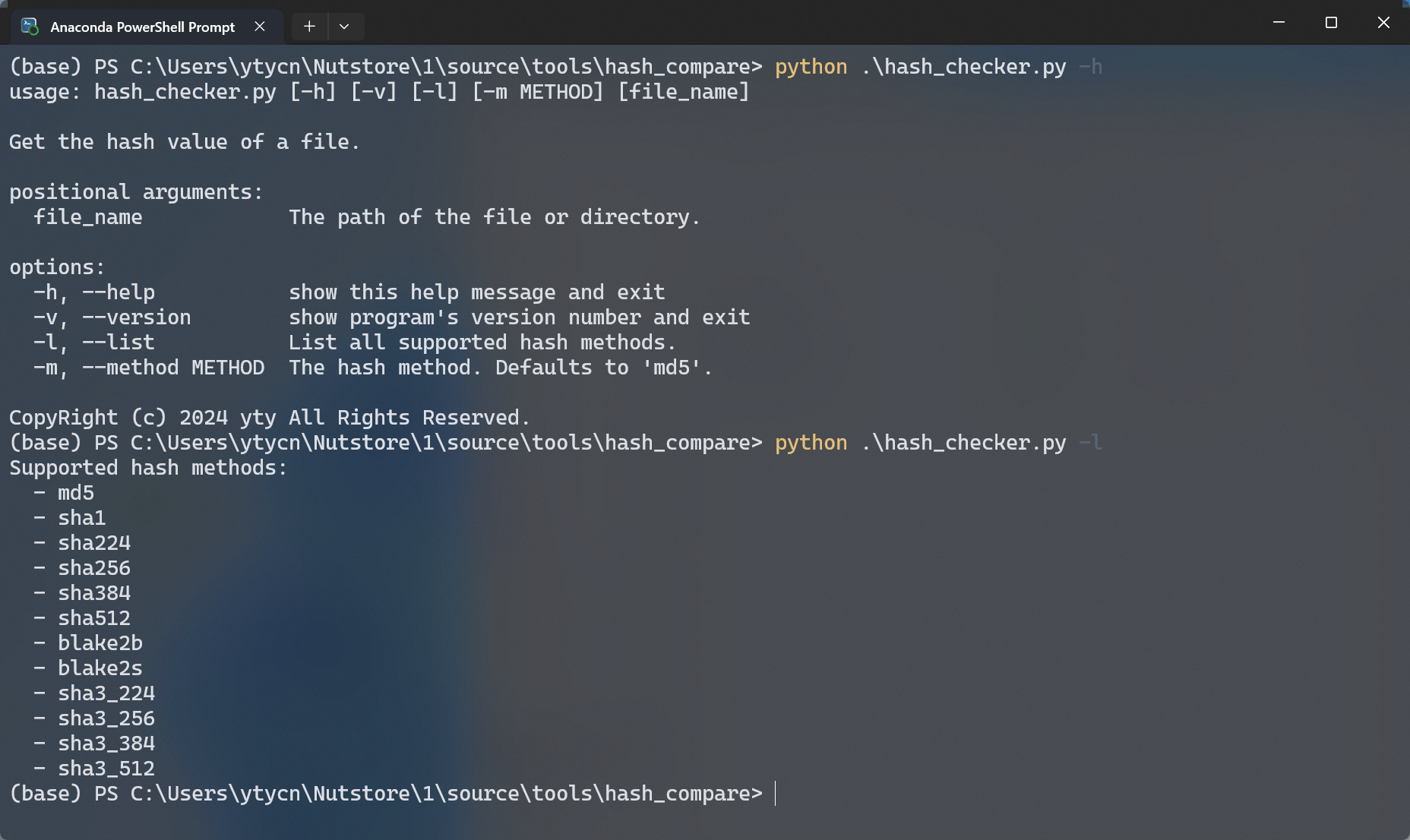
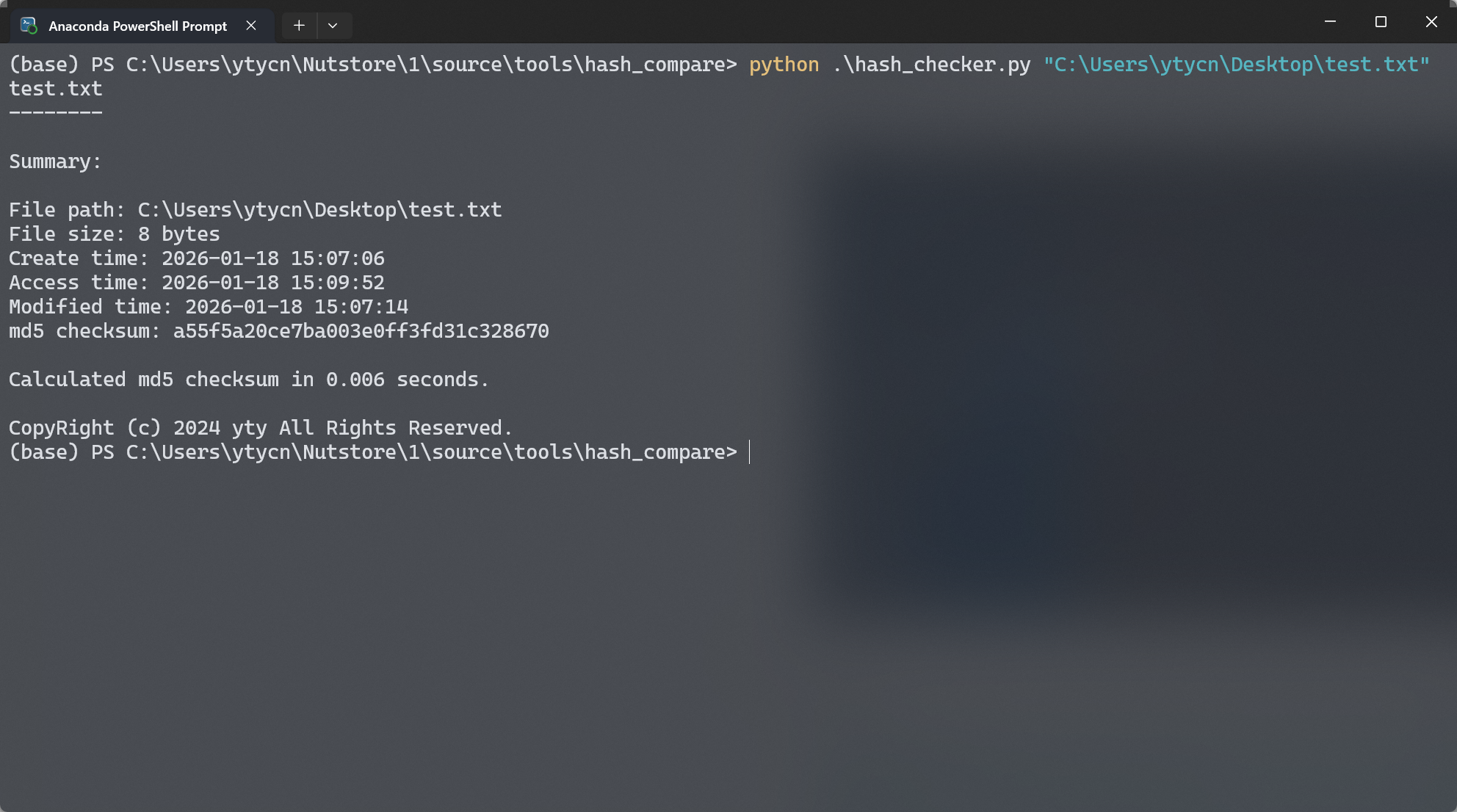
代码如下:
# -*- coding: UTF-8 -*-
"""hash_checker - Get the hash value of a file.
Usage:
    hash_checker.py [-h] [-v] [-l] [-m METHOD] [file_name]
Options:
  -h, --help            show this help message and exit
  -v, --version         show program's version number and exit
  -l, --list            List all supported hash methods.
  -m, --method METHOD   The hash method. Defaults to 'md5'.
  file_name             The path of the file or directory.
Example:
    $ hash_checker.py a.txt
    $ hash_checker.py -m sha256 a.txt
CopyRight (c) 2024 yty All Rights Reserved.
"""
import hashlib
import argparse
import os
import os.path
import time
supported_method = ('md5', 'sha1', 'sha224', 'sha256', 'sha384', 'sha512',
                    'blake2b', 'blake2s',
                    'sha3_224', 'sha3_256', 'sha3_384', 'sha3_512',
                    )
def get_hash(file_path, method="md5"):
    """Get the hash value of a file.
    Args:
        file_path(str): The path of the file.
        method(str, optional): The hash method. Defaults to 'md5'.
    Returns:
        str: The hash value of the file as a hexadecimal string.
    """
    if method not in supported_method:
        raise ValueError(f"Unsupported hash method: {method}")

    # Open the file and get the hash
    with open(file_path, 'rb') as f:
        # Use the hashlib.file_digest() method to calculate the hash value of the file.
        # This method bypass Python's I/O and use techniques such as zero-copy, improving
        # the efficiency of file hashing.
        hasher = hashlib.file_digest(f, method)
        # A Slower implementation
        # hasher = hashlib.new(method)
        # while True:
        #     # Buffer size of 4096
        #     data = f.read(4096)
        #     if not data:
        #         break
        #     # Update the hash object
        #     hasher.update(data)
    # return the hash as a hexadecimal string
    return hasher.hexdigest()
def main():
    start = time.time()
    # Parse the command line arguments
    parser = argparse.ArgumentParser(
        prog="hash_checker.py",
        description="Get the hash value of a file.",
        epilog="CopyRight (c) 2024 yty All Rights Reserved."
    )
    parser.add_argument("-v", "--version", action="version", version="hash_checker (v1.0.0)")
    parser.add_argument("-l", "--list", action="store_true", help="List all supported hash methods.")
    parser.add_argument("-m", "--method", type=str, default="md5", metavar="METHOD",
                        choices=supported_method, help="The hash method. Defaults to 'md5'.")
    parser.add_argument("file_name", type=str, nargs="?", help="The path of the file or directory.")
    args = parser.parse_args()
    # List all supported hash methods
    if args.list:
        print("Supported hash methods:")
        for method in supported_method:
            print(f"  - {method}")
        exit(0)
    # Get the hash value of the file
    if args.file_name is None:
        parser.error("Please specify a file name.")
    file_path = args.file_name
    hash_value = get_hash(file_path, args.method)
    end = time.time()
    # Summary
    abs_path = os.path.abspath(file_path)
    stat = os.stat(file_path)
    print(os.path.basename(abs_path))
    print("-" * len(os.path.basename(abs_path)))
    print()
    print("Summary:")
    print()
    print(f"File path: {abs_path}")
    print(f"File size: {stat.st_size} bytes")
    try:
        print(f"Create time: {time.strftime('%Y-%m-%d %H:%M:%S', time.localtime(stat.st_birthtime))}")
    except AttributeError:
        pass
    print(f"Access time: {time.strftime('%Y-%m-%d %H:%M:%S', time.localtime(stat.st_atime))}")
    print(f"Modified time: {time.strftime('%Y-%m-%d %H:%M:%S', time.localtime(stat.st_mtime))}")
    print(f"{args.method} checksum: {hash_value}")
    print()
    print(f"Calculated {args.method} checksum in {end - start:.3f} seconds.")
    print()
    print("CopyRight (c) 2024 yty All Rights Reserved.")
if __name__ == '__main__':
    main()